Why You Wake Up at 3am: The Nervous System Explanation No One Gave You
2:58am. You know this without checking your phone, because your body has started doing this on a schedule now. Eyes open. Heart already going a little too fast. And somewhere behind your sternum, a list of everything unfinished starts unspooling like it has been waiting all day for this exact moment to talk.
Here is the part that makes this specifically a midlife thing, not just a sleep thing: falling asleep was never the problem. You went down fine at 10:30. This is something else. Sleep researchers call it sleep-maintenance insomnia, and it is a different animal from the trouble-falling-asleep most people picture when they hear the word insomnia. You are not lying there for an hour waiting to drift off. You are being pulled out of sleep that was already working.
If this is familiar, you have probably already been told it is cortisol. Your cortisol is spiking. Fix the cortisol, fix the waking. It is tidy advice, and it is also not quite right.
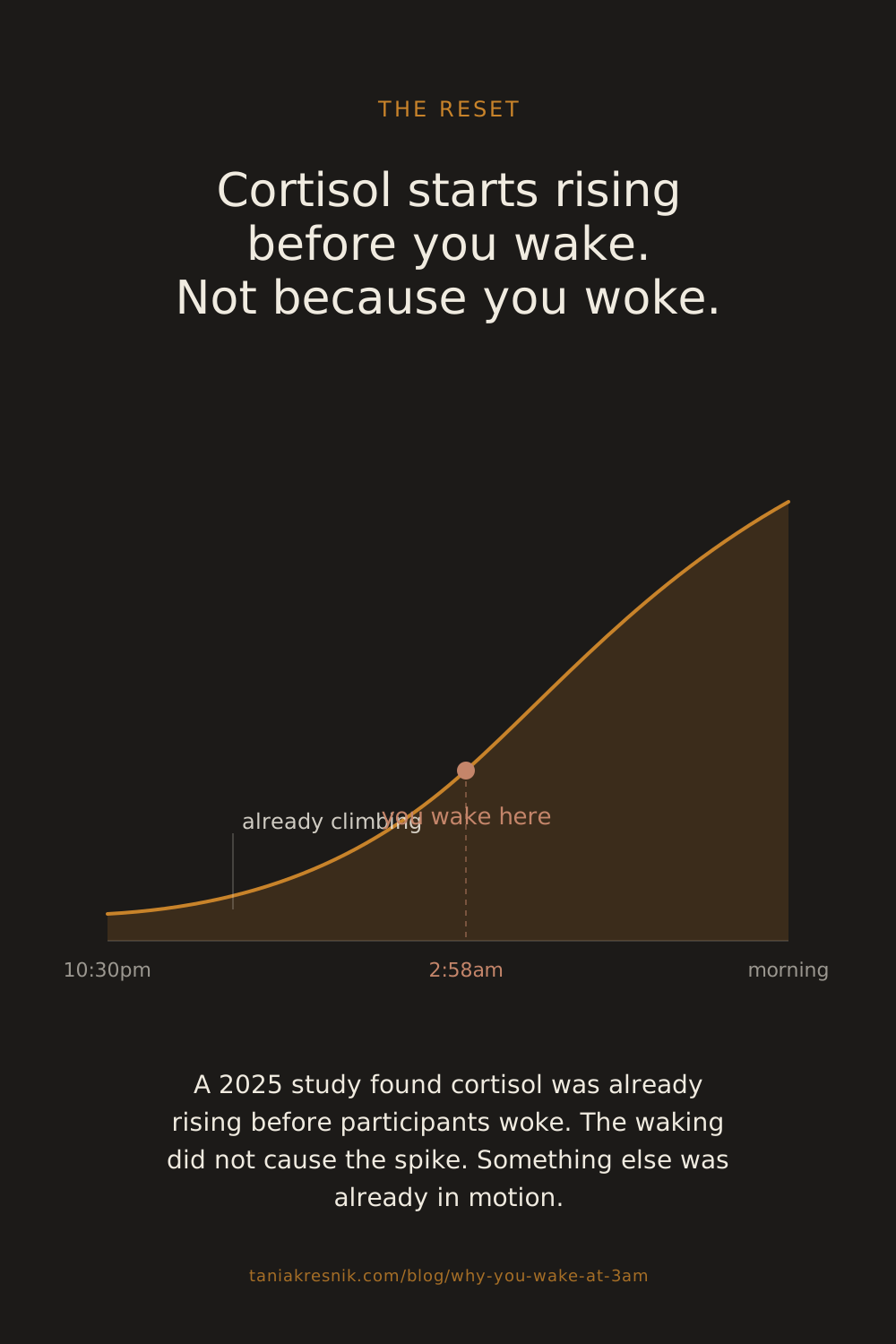
The cortisol rise may begin before you wake, not because you woke
Cortisol does rise toward the end of the night, that part is well established. What researchers are still debating is how much of the familiar morning rise is triggered by waking itself, and how much is already under way before your eyes open.
A 2025 study using continuous subcutaneous sampling in 201 healthy volunteers found that cortisol secretion was already increasing before participants woke, and did not suddenly accelerate at the moment of waking. That does not make cortisol irrelevant. It means the simple story, you woke because cortisol suddenly spiked, is probably too tidy.
Your body may already have been moving toward a more alert phase, and something else tipped you fully into consciousness during the naturally lighter sleep of the second half of the night.
Your nervous system, not your hormones, is the better suspect
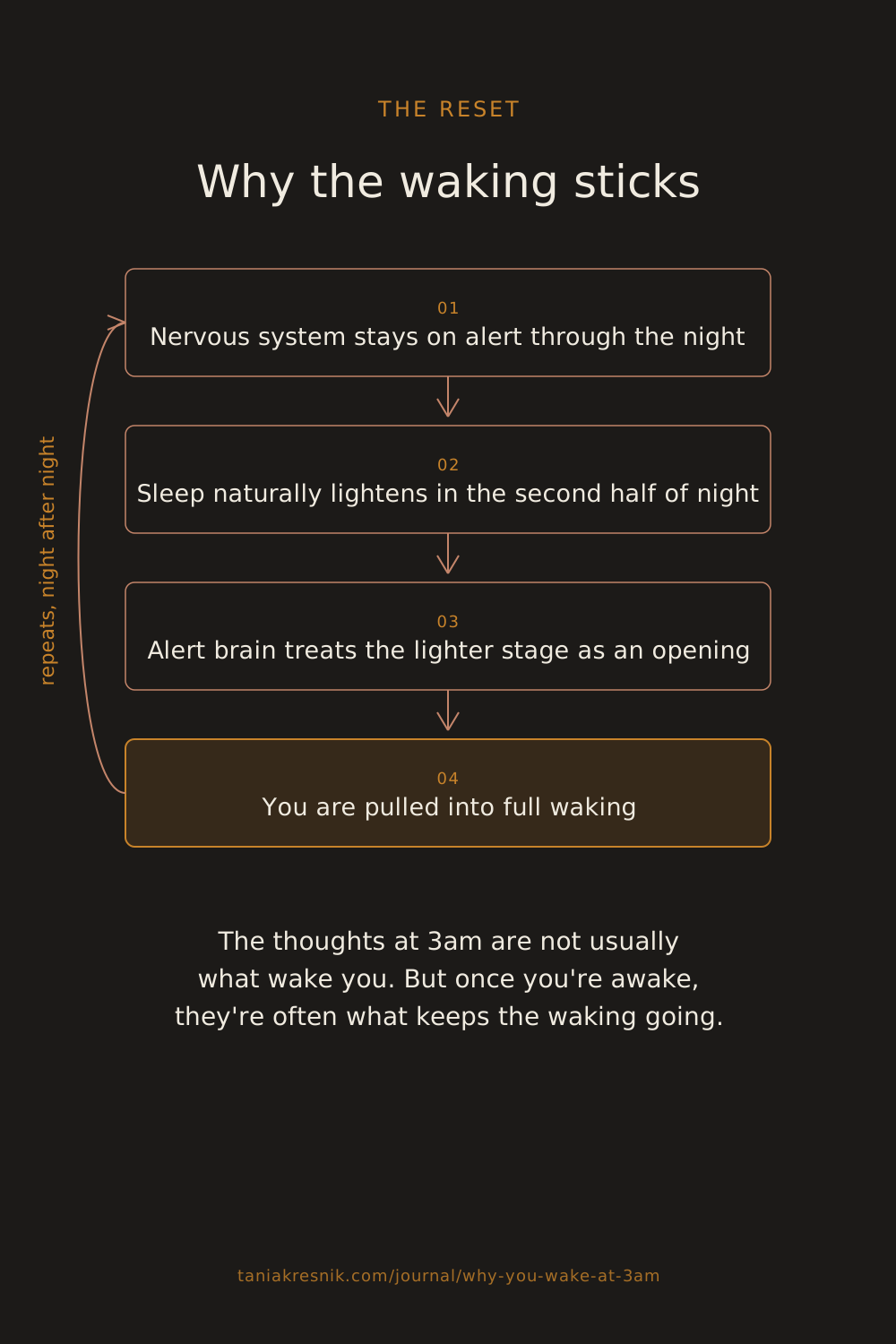
The researchers who study chronic insomnia have a term for what is going on underneath all this: hyperarousal. Not a metaphor, a measurable state where the sympathetic nervous system stays more switched on than it should be, even during sleep. People with high sleep reactivity are simply more vulnerable to stress disrupting their sleep, both in falling asleep and in staying asleep once they are under.
In plain terms: your brain has learned to treat the night as a place where it still needs to keep watch. When sleep naturally gets lighter in the second half of the night, and it does, for everyone, a brain on high alert treats that lighter stage as an opening. And it takes it.
For many people, sustained stress and hyperarousal are part of the picture. But night waking can also be related to hot flashes, sleep apnea, pain, reflux, alcohol, medication effects, thyroid conditions, bladder symptoms, and other medical factors. If the pattern is new, severe, or accompanied by snoring, gasping, chest symptoms, or marked mood changes, it deserves a medical conversation rather than another sleep technique.
The racing thoughts may not cause the waking. But they often make it stick.
The thoughts that show up at 3am may not be what woke you. But once you are awake, they are often what keeps the waking going. A 2025 University of Zagreb study found a two-way relationship between stress and sleep quality, where rumination was a real part of the pathway connecting the two. Stress disrupts sleep partly because the mind will not put the stressor down. Bad sleep makes the next day's stress harder to handle, which feeds the cycle again the following night.
There is a way of putting this that is more useful than any single statistic: the 3am waking usually is not the moment a problem starts. It is the moment your mind finally gets quiet enough for whatever you did not deal with during the day to get loud.
You are not malfunctioning. You are just finally hearing something that has been waiting all day for the noise to stop.
There is an older framework that lands on something similar
Long before cortisol had a name, Traditional Chinese Medicine was making its own observations about why people wake at specific hours. The TCM organ clock divides the night into two-hour windows. 1am to 3am sits in Liver time, linked to stress, frustration, and qi stagnation. 3am to 5am sits in Lung time, linked to grief and difficulty letting go.
None of this is a medical diagnosis. There is no clinical evidence that a 3am waking means your liver is malfunctioning, and the TCM framework is not a scientifically equivalent system to the cortisol and hyperarousal research above. But as a reflective lens, it offers an intriguing thematic overlap, and no reason to confuse reflection with diagnosis.
This is also not just anxiety, and it is not nothing either
The research backs up what you probably already suspect: disrupted sleep and anxiety feed each other in both directions. A nine-year longitudinal study following middle-aged and older adults found that insomnia symptoms significantly predicted later anxiety symptoms, not just the reverse. Treating the sleep side directly, instead of waiting to feel calmer first, can be the more effective entry point.
Before the techniques: a note on causes
A 3am waking is not automatically a stress problem. Persistent night waking can also be related to hot flashes, sleep apnea, pain, acid reflux, alcohol, medication effects, thyroid conditions, bladder symptoms, depression, or other medical factors. The techniques below work well for stress-related hyperarousal. If your waking pattern is new, severe, or comes with other symptoms, snoring, gasping, chest tightness, significant daytime sleepiness, or marked mood changes, please speak with a doctor before treating it as a sleep hygiene issue.
What the evidence says actually helps
The treatment with the most consistent research behind it is CBT-I, cognitive behavioral therapy for insomnia. It is not a single trick but a small set of behavioral shifts, and two of them are worth knowing right now.
Stimulus control: if you are clearly awake, mentally switched on, and becoming frustrated, get out of bed and sit somewhere dim and quiet. Return only when you feel sleepy again. The aim is to stop the brain learning that bed is a place for wakefulness, effort, and frustration. Watching the clock makes it worse. The cue to leave is frustration, not a specific number of minutes.
Constructive worry: earlier in the evening, not at midnight, write down each unresolved concern and one practical next step. The point is not to solve anything. It is to give your brain evidence that these things have a place to be handled, so it has less reason to drag them out at 3am when you cannot act on any of it anyway.
Neither is a one-night fix. These techniques work through repetition, as the brain gradually relearns the relationship between bed, wakefulness, and sleep.
Why this matters more in your forties and fifties
Midlife adds real variables: hormonal shifts, the layered stress of caregiving, careers at their most demanding stretch right as recovery capacity starts to feel less automatic. None of that means the waking is permanent. It means the nervous system has more to process, more often, with less built-in slack, which is exactly why something that works with the body's stress response does more than something that just tries to talk you back to sleep.
The piece that text cannot do
This post explains what is happening in your body at 3am. That is the first thing. But explanation is not the same as practice, and practice is not something you can read your way through.
Part 1 of The Midnight Reset is the version of this post that you listen to in the dark, at the hour it is actually happening. Part 2 guides the body scan and the breathwork in real time. Not described. Done with you.
If tonight is a 3am night, the audio is here: The Midnight Reset.
If you want to read more first, the evening routine post is a useful next step.
You are not broken at 3am. You are just finally quiet enough to hear what has been waiting.
References
Klaas, S., Upton, T. J., Zavala, E., et al. (2025). Cortisol awakening response: fact or fiction? A subcutaneous microdialysis study in a home setting. Proceedings of the Royal Society B, 292(2038), 20241844. https://doi.org/10.1098/rspb.2024.1844
Stalder, T., Oster, H., Abelson, J. L., et al. (2025). The Cortisol Awakening Response: Regulation and Functional Significance. Endocrine Reviews, 46(1), 43–59. https://doi.org/10.1210/endrev/bnae024
Petak, A., & Maričić, J. (2025). The Role of Rumination and Worry in the Bidirectional Relationship Between Stress and Sleep Quality in Students. International Journal of Environmental Research and Public Health, 22(7), 1001. https://doi.org/10.3390/ijerph22071001
Zagaria, A., & Ballesio, A. (2024). Insomnia symptoms as long-term predictors of anxiety symptoms in middle-aged and older adults from the English Longitudinal Study of Ageing (ELSA), and the role of systemic inflammation. Sleep Medicine, 124, 120–126. https://doi.org/10.1016/j.sleep.2024.09.020
Edinger, J. D., Arnedt, J. T., Bertisch, S. M., et al. (2021). Behavioral and psychological treatments for chronic insomnia disorder in adults: An American Academy of Sleep Medicine clinical practice guideline. Journal of Clinical Sleep Medicine, 17(2), 255–262. https://doi.org/10.5664/jcsm.8986
This post is for informational purposes only and does not constitute medical advice. If you are experiencing chronic insomnia or other sleep concerns, please speak with a qualified healthcare provider.