The Evening Routine That Actually Works: What the Sleep Science Says
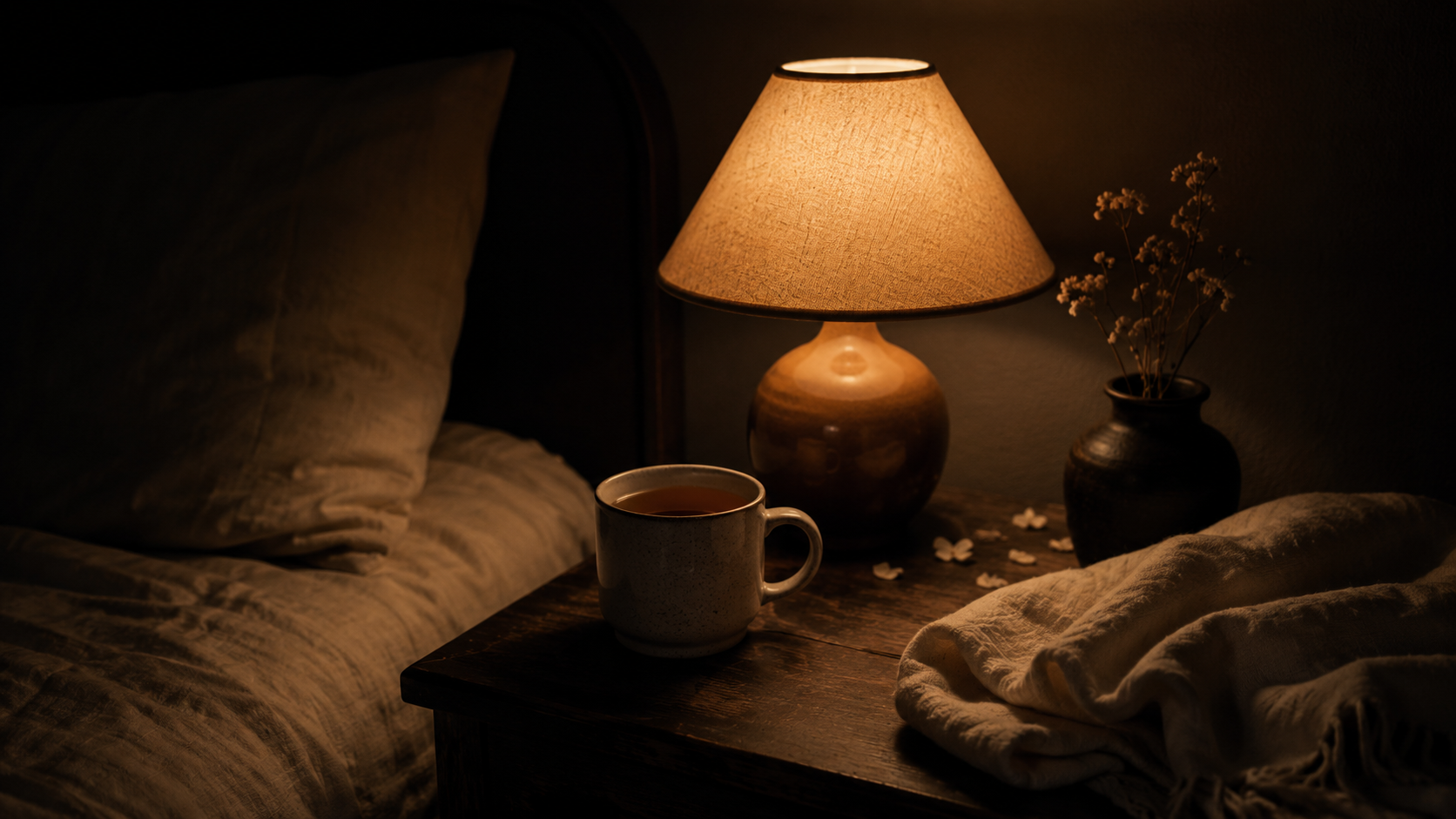
Your kitchen light might be doing more to your sleep than you think.
In 2011, researchers at Harvard and Brigham and Women's Hospital found something still cited in nearly every serious sleep study since. Ordinary indoor room light, the kind sitting in your ceiling fixture right now, delayed melatonin onset in almost everyone exposed to it before bed. It also shortened how long melatonin stayed elevated through the night, by about ninety minutes. Not a screen. Not blue light. Ordinary light, under 200 lux, against a properly dim room.
Most evening routine advice skips straight to phones and stops there, as if phones invented the problem. They didn't. They added one more source of light and delay to a room already telling your body it's still daytime.
What's actually competing for your attention at 9pm
Three things have to line up reasonably well before sleep happens: enough sleep pressure built up from being awake, a circadian signal telling your body it's night, and a nervous system allowed to come down off alert. Miss one, and you can be exhausted and still wide awake at midnight.
Light governs the circadian piece. Your eyes carry cells tuned specifically to daytime light, and when they fire in the evening, they tell your internal clock to hold off on melatonin. The Harvard study found this happens with regular household lighting, not only screens. Dimming the lamp matters as much as putting the phone down. Sometimes more.
The screen issue is real. Blue light isn't the whole story.
A 2025 Norwegian survey of more than 45,000 young adults, mostly university students, found each extra hour of screen use after getting into bed was linked to 59 percent higher odds of insomnia symptoms, and about 24 minutes less sleep. Social media wasn't worse than any other screen activity. Time spent mattered more than what was on the screen.
This was a cross-sectional survey, not a study following people over time, so it can't prove screen use caused the poor sleep. People who already struggle to fall asleep might reach for their phone more too. Both directions are possible.
Scrolling delays the moment you actually try to sleep, and it keeps part of your brain doing what brains do when engaged: processing, reacting, deciding whether to respond. None of that settles a nervous system down. A blue light filter won't fix a mind still working through a group chat at 11pm.
Why "just relax" doesn't work, and what does
Tell your jaw to unclench and it tightens anyway. Telling a nervous system to calm down isn't an instruction it follows. Calm is a process, and the process needs something physical to do.
Progressive muscle relaxation falls under relaxation therapy, a category with a conditional recommendation from the American Academy of Sleep Medicine for chronic insomnia. Tense a muscle group, hold it, release it, move through the body. It gives the nervous system something concrete to let go of, instead of asking it to release nothing in particular. Multi-component CBT-I remains the recommended first approach for chronic insomnia. Muscle relaxation can sit inside it, or stand on its own.
Warm baths work through a different lever: temperature. Falling asleep is tied to your core body temperature dropping. A warm bath an hour or two before bed increases blood flow to your hands, feet, and skin, and the cooling afterward supports your body's natural pre-sleep temperature drop. Research on this found bathing or showering in that window, even for around ten minutes, linked to falling asleep faster.
The bedtime writing thing that actually held up in a lab
Researchers at Baylor ran people through overnight polysomnography, the gold standard, electrodes on the scalp, after having them spend five minutes before bed writing one of two things: a to-do list for the days ahead, or a list of what they'd already finished.
The to-do list group fell asleep faster. One plausible explanation: putting unfinished tasks on paper reduces the need to keep rehearsing them mentally, which differs from rumination even though it looks similar on the surface.
Worth being honest about the size of this: 57 healthy adults in their twenties, one night, in a lab. Real and well conducted, but not proof it works the same way for someone with years of disrupted sleep. Promising. Not guaranteed.
The part almost nobody mentions: same time, every night
A UK Biobank study following over 72,000 adults aged 40 to 79 found irregular sleep timing linked to a 26 percent higher risk of major cardiovascular events, even among people getting a recommended amount of sleep overall.
This is population-level research, not a forecast of what happens to you personally after a few uneven nights. The study measured overall sleep regularity, bedtime, wake time, duration, night waking, day-to-day variability, not evening routines specifically. It didn't test whether a wind-down ritual changes the outcome.
Still, it reframes what a routine is for. Not a checklist of calming activities. A repeated cue, at a consistent hour, telling your body what comes next. The content of the routine matters less than most people assume. The timing might matter more.
What the practice actually looks like
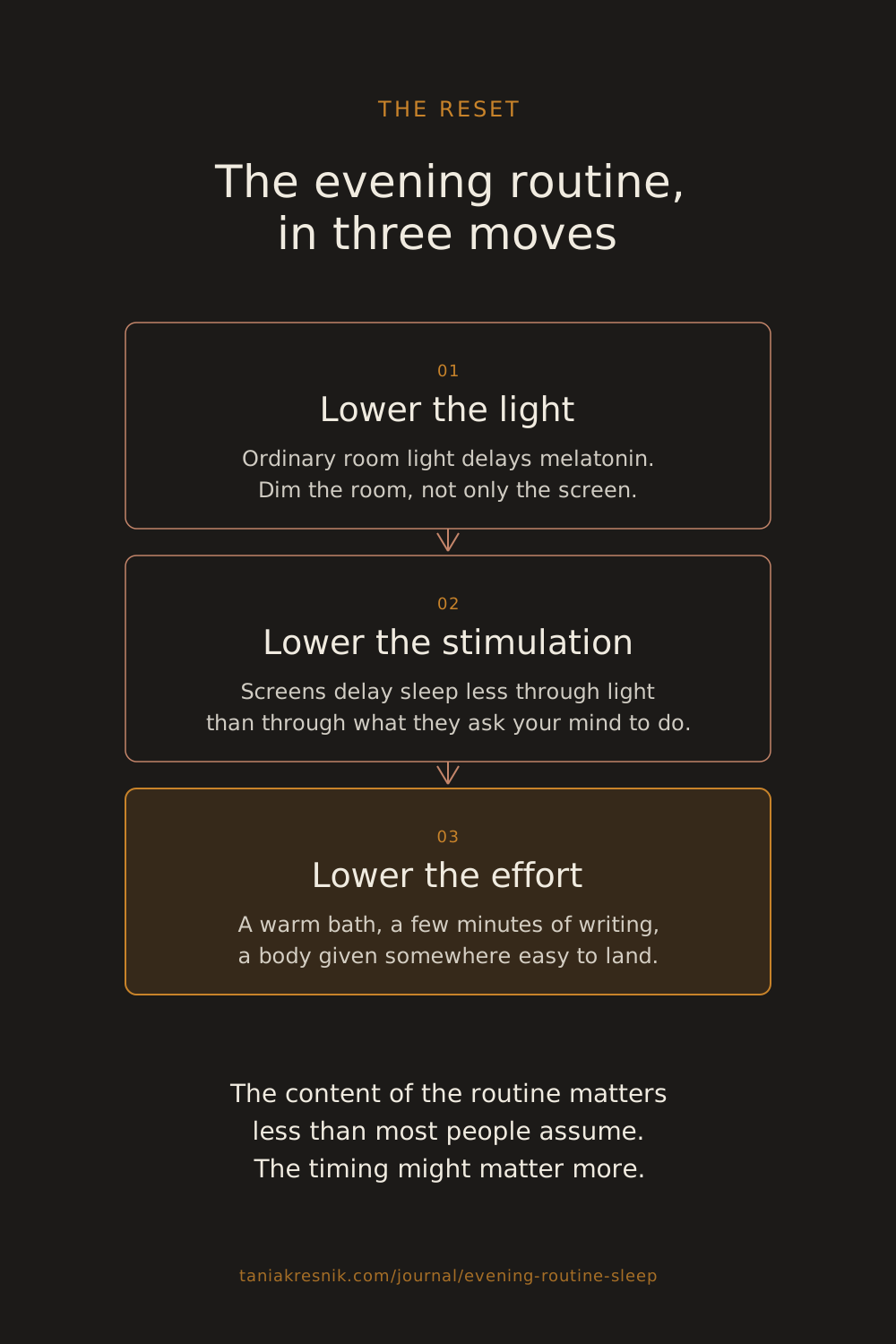
Lower the light. Lower the stimulation. Lower the effort. That's the whole method, and everything above is one of three ways to do it.
Somewhere in the final half hour to hour before your target bedtime, the room lights come down, not only the phone screen. Screens finish earlier in the evening. The last stretch belongs to something lower stimulation: a warm bath, a few minutes of muscle relaxation, five minutes writing down what's unresolved so it has somewhere to sit besides your head. Roughly the same time most nights, because the schedule does real work even on nights when nothing else lands.
None of this is elaborate. None of it is a hack. It's a small set of things that lower light, lower stimulation, and lower arousal, done consistently enough your body stops guessing what comes next.
When the routine has done what it can
An evening routine can lower how much light, stimulation, and unresolved effort you carry into bed. It can't guarantee stress, hormonal change, pain, or a naturally lighter stage of sleep won't wake you later.
The Midnight Reset is built for that second moment: the routine is over, the room is dark, and you're awake anyway. Part 1 explains what's happening in your body and why fighting the waking usually makes it louder. Part 2 is a guided sequence, breathwork, a full-body scan, a warmth practice, and a closing practice for racing thoughts, done in real time.
If falling asleep is your main problem, start with the routine above. If you fall asleep fine and wake with your mind fully online at 3am, the audio is here: The Midnight Reset.
You can also read the full explanation of the 3am waking in the companion post.
References
Gooley, J. J., Chamberlain, K., Smith, K. A., et al. (2011). Exposure to room light before bedtime suppresses melatonin onset and shortens melatonin duration in humans. Journal of Clinical Endocrinology & Metabolism, 96(3), E463–E472. https://doi.org/10.1210/jc.2010-2098
Hjetland, G. J., Skogen, J. C., Hysing, M., Gradisar, M., & Sivertsen, B. (2025). How and when screens are used: Comparing different screen activities and sleep in Norwegian university students. Frontiers in Psychiatry. https://pubmed.ncbi.nlm.nih.gov/40270574
Edinger, J. D., Arnedt, J. T., Bertisch, S. M., et al. (2021). Behavioral and psychological treatments for chronic insomnia disorder in adults: An American Academy of Sleep Medicine clinical practice guideline. Journal of Clinical Sleep Medicine, 17(2), 255–262. https://doi.org/10.5664/jcsm.8986
Haghayegh, S., Khoshnevis, S., Smolensky, M. H., Diller, K. R., & Castriotta, R. J. (2019). Before-bedtime passive body heating by warm shower or bath to improve sleep: A systematic review and meta-analysis. Sleep Medicine Reviews, 46, 124–135. https://pubmed.ncbi.nlm.nih.gov/31102877/
Scullin, M. K., Krueger, M. L., Ballard, H. K., Pruett, N., & Bliwise, D. L. (2018). The effects of bedtime writing on difficulty falling asleep: A polysomnographic study comparing to-do lists and completed activity lists. Journal of Experimental Psychology: General, 147(1), 139–146. https://pubmed.ncbi.nlm.nih.gov/29058942
Chaput, J-P., et al. (2024/2025). Sleep regularity and major adverse cardiovascular events: A device-based prospective study in 72,269 UK adults. Journal of Epidemiology & Community Health. https://pubmed.ncbi.nlm.nih.gov/39603689/
This post is for informational purposes only and does not constitute medical advice. If you are experiencing chronic insomnia or other sleep concerns, please speak with a qualified healthcare provider.